Why Hidden Information Changes a Game’s Table Talk
Hidden information changes a game’s table talk by making questions, pauses and confident claims part of the play, not just conversation around it.
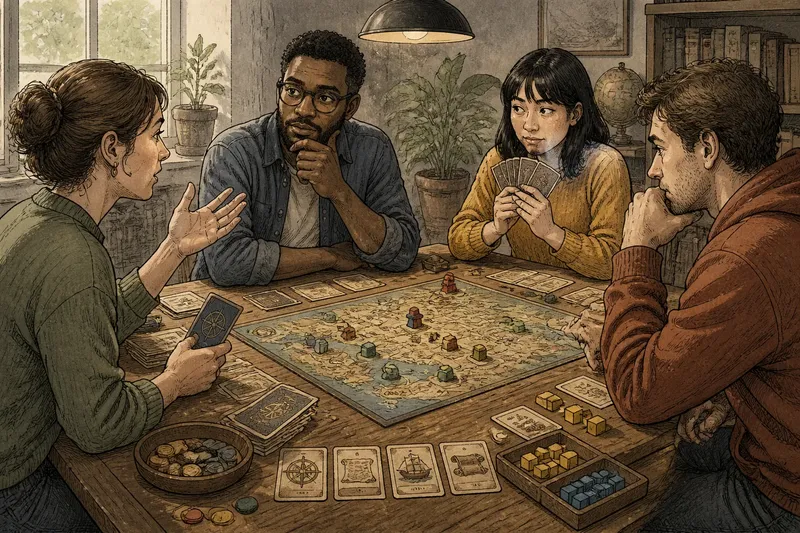
The common mistake with hidden information is treating silence as wasted time. In games with secret cards, concealed goals or private clues, that silence can cost a player a chance to learn what others are thinking. Hidden information changes a game’s table talk because players must decide not only what to do, but what their words will reveal.
1. A question can become a move
In an open-information game, asking how many resources someone has may simply clarify the position. If that number is concealed, the same question can probe a rival’s plans or signal what you intend to target. Conversation begins to affect the game even when the rules do not assign it a formal action.
This changes how players listen. A casual question about a colour, location or previous choice may be useful because it invites a response without openly demanding a secret. The answer can be informative, but so can a refusal, a joke or an abrupt change of subject.
Say you hold a private card that scores when a particular symbol appears. You ask whether anyone has seen that symbol, then watch who answers quickly and who checks their cards before replying. You have not learned anyone’s hand, but the exchange gives you clues about confidence and attention.
Keep questions tied to the current decision. A broad interrogation can feel intrusive and slow the table; a precise question gives others something meaningful to answer or decline.
2. Claims become evidence, but not proof
Players may describe a private position truthfully, mislead, or leave out the detail that matters most. The table has to interpret each claim in context. A statement is not a reliable fact simply because it was spoken aloud; it is one more piece of information to weigh.
That ambiguity creates a distinctive social rhythm. Players compare claims with visible actions: someone who says a route is harmless may still avoid taking it, while a player who denies holding a resource may spend a turn pursuing a different objective. Neither behaviour settles the matter, but each can change what others consider plausible.
Good table talk leaves room for uncertainty. If players treat every hesitation as an admission or every boast as a lie, conversation collapses into accusation. Instead, ask what a statement would mean if it were true, and what the speaker might gain if it were false.
Separate what you saw from what you inferred. That small distinction keeps discussion sharper and less personal.
3. Silence and timing acquire meaning
When information is concealed, a pause can attract attention. A player might be weighing a risky choice, checking a private objective or simply taking time to understand the board. Other players can notice the pause, but they cannot know its cause without more evidence.
Timing matters in games where players take turns making offers, accusations or selections. Speaking before a rival commits may invite them to change course; waiting until after their move may expose that your question was aimed at a particular possibility. Even a delayed answer can feel significant when everyone knows that the relevant fact is private.
Do not turn every pause into a performance. Some people need more time to process rules or choose an action, and forcing them to explain their thinking can make a game less comfortable. Focus on decisions that the game makes consequential, rather than reading ordinary habits as secret signals.
Let timing inform a guess, not replace the evidence.
4. Private goals split the table’s apparent priorities
A player with a concealed objective may pursue an action that looks inefficient to everyone else. They might collect a modest resource, avoid a lucrative route or support a move that seems to benefit a rival. The visible board tells only part of the story because each person may value it differently.
This makes table talk a negotiation over explanations. The player can offer a plausible public reason for an unusual choice, while others decide whether that explanation fits the available information. The uncertainty can make a small decision socially charged without changing the physical components at all.
For the person holding the secret, the challenge is to pursue the goal without making every action point directly towards it. For everyone else, the challenge is to distinguish a genuine mistake or long-term plan from an attempt to conceal a private scoring condition.
When discussing motives, describe the move before judging the player. “That choice leaves the northern route open” invites analysis; “You are obviously helping them” turns a guess into a personal accusation.
5. Public clues give private knowledge something to attach to
Hidden information works best at the table when players have something visible to reason from. A face-down card alone offers little to discuss. A shared discard pile, a public draft, a sequence of revealed clues or a board position can give that concealed card context.
Players then combine what they can see with what they remember. If a card has appeared in the discard pile, it cannot be in another player’s hand; if someone repeatedly avoids a particular space, that pattern might matter. The table talk becomes a process of connecting public evidence to private possibilities.
Memory has limits, so keep the discussion grounded in details everyone can check. Point to the revealed card or restate the sequence of moves rather than relying on a vague claim that someone “always” behaves a certain way. This makes inference easier to follow and reduces disputes about what happened.
Use visible clues to support a theory, not to pretend that uncertainty has disappeared.
6. Bluffing changes the value of confidence
In a bluffing game, a confident declaration may be a deliberate attempt to shape another player’s choice. A hesitant claim may be honest, or it may be designed to look honest. Confidence itself becomes part of the performance, so players must consider both the statement and the reason it was made.
The most useful bluff is not necessarily the most dramatic one. A small, credible claim can steer attention away from a private card or encourage a rival to spend a turn checking the wrong possibility. A player who overstates every hand, however, gives the table little reason to treat any boast as meaningful.
For listeners, look for incentives. Ask what the speaker gains if you believe the claim, what they gain if you challenge it, and whether either outcome fits the public position. This is more useful than trying to label someone a naturally convincing or unconvincing person.
Challenge the claim, not the character of the person making it.
7. Clear boundaries keep secrets playful
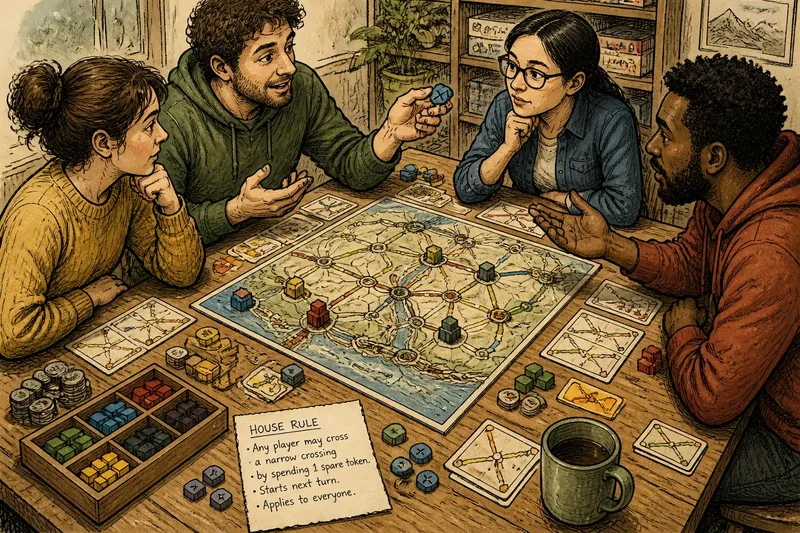
Private information can create tension, but the table should still agree on what kind of talk the game permits. Some games invite direct lying; others allow bluffing only through specific actions, or make certain facts off-limits to disclose. If players have different expectations, a clever exchange can feel like a breach rather than a fun decision.
Before play, clarify whether players may show cards, quote exact wording from private objectives, make promises about future turns or discuss information after it has been revealed. The rulebook or a particular game component may settle these points; follow that wording rather than relying on assumptions from another game.
Also make room for players who prefer not to bluff in character. They can still take part by analysing incentives, asking neutral questions or deciding when to trust a claim. The social texture should come from choices in the game, not pressure to perform a particular personality.
Agree on the boundaries before a secret becomes the subject of an argument.
What do players ask about hidden information?
Does hidden information always mean players can lie?
No. A game may keep cards, objectives or clues private without permitting false statements about them. Check the rules for what players may say, and distinguish voluntary silence from an authorised bluff.
How can a player infer a secret without seeing it?
Combine public evidence, such as revealed cards and earlier choices, with the incentives behind a player’s current move. Treat the result as a possibility rather than a fact until the game reveals more.
What should I say if I do not want to reveal my hand?
Keep your reply within the rules: you can decline to answer, give a broad response or redirect attention to the public position if the game allows it. Decide with the group beforehand whether direct questions require an answer.
Can hidden information work for a quiet group?
Yes. Players can share theories only when they have a useful observation, and a game can still reward careful choices without constant banter. Look for rules that make concealed information matter through decisions rather than persuasive speeches alone.
Make the conversation serve the decision
Hidden information gives table talk a second job: it helps players choose while also shaping what others believe about those choices. Questions can probe, claims can misdirect, and public clues can narrow a field of possibilities, but none of these turns uncertainty into certainty.
When you next play a game with secret cards or private goals, pick one decision and ask what each person knows, what they have chosen to say and what their action suggests. That simple habit makes the game’s distinctive conversation easier to follow—and keeps a clever inference from becoming an accusation.