A Shared Board or a Personal Play Area?
A shared board or personal play area can shape how a group plays. Choose a layout that keeps the action visible without crowding players.
The common mistake with a shared board or personal play area is choosing whichever layout looks tidiest before anyone sits down. That can leave players reaching across one another, or make a central board so distant that people stop noticing what others are doing. Start with the room, the game’s components and the group’s habits; then arrange the playing space to make the important actions easy to see and reach.
Choose the layout around the game’s main action
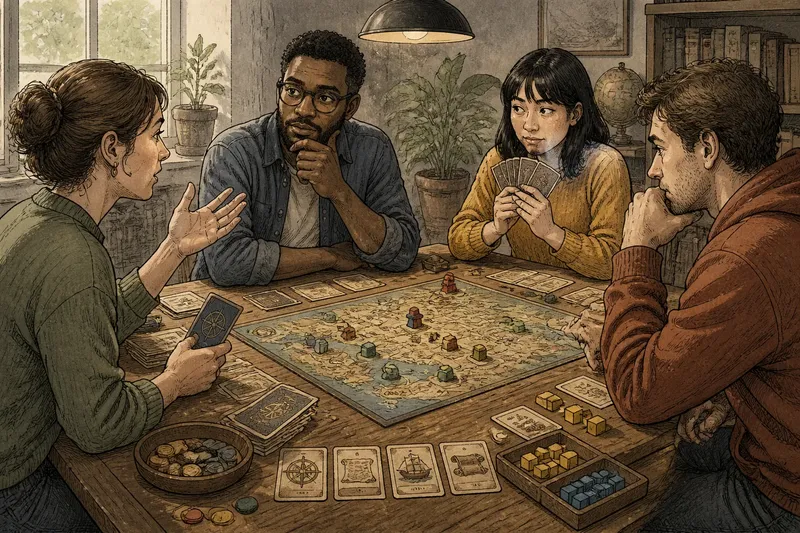
A shared board suits play that repeatedly brings everyone’s attention to the same place. A route map, market, central puzzle or common supply can give the group a natural visual anchor. Each player still needs a place for cards, tokens and reference material, but the central area carries the changing state that everyone must read.
Personal play areas work well when each player manages a distinct tableau, hand of cards, set of tiles or collection of resources. A player can inspect and arrange their own pieces without obstructing the common view. If turns mainly involve choices made within those individual spaces, a large shared surface may add reach and clutter without adding useful interaction.
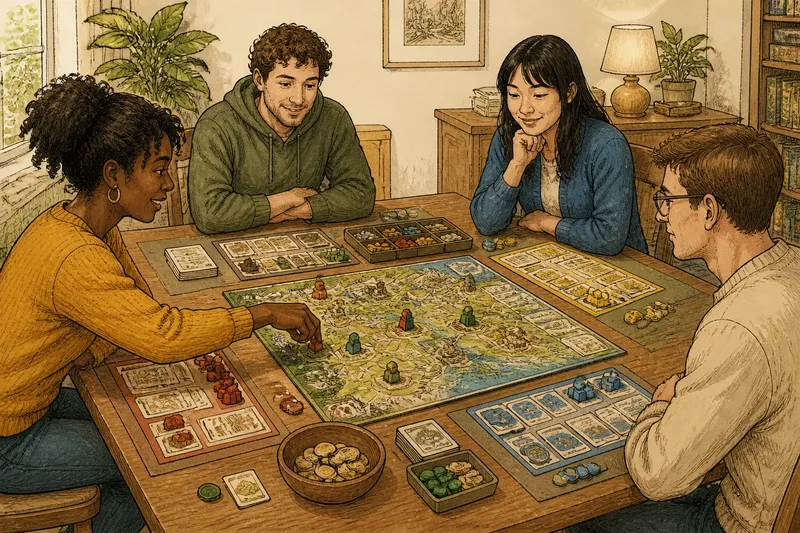
Many games call for both. A shared board can hold the common map or objective while each person keeps a compact area for their own pieces. Treat the two zones as connected parts of one table, not as competing layouts.
Ask what players must look at during a typical turn. Give that information the clearest, most accessible position.
Measure the usable table, not its outline
A dining table’s full surface is not necessarily playing space. Plates, a lamp base, a table edge against a wall, or a player’s limited reach can reduce the area that is actually useful. Before laying out components, clear what can be moved and check where each person will sit. A layout that technically fits may still make routine actions awkward.
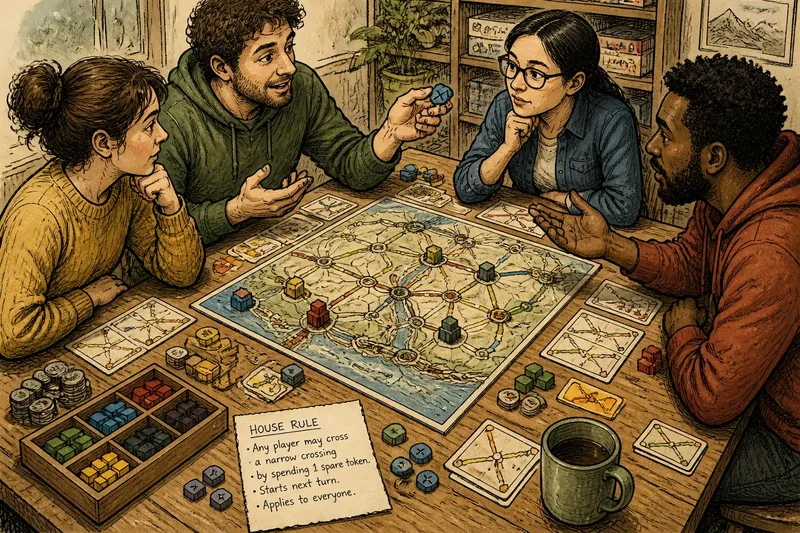
For a shared board, leave room around the edges for players to place or take pieces without leaning across the whole table. If the board is wide, consider turning it so the longest reach is across fewer seats. For personal areas, give each player a clearly bounded patch and keep common components where all can reach them. The patches need not be identical if the seating arrangement is uneven, but no player should have to guard a small area from passing hands.
Say you are hosting a game with a map in the middle and a few cards and tokens for each player. If the table has a wall behind one side, put the map nearer the centre and seat the player who needs to consult it most often where they can see it without twisting. Place personal pieces in front of each seat, leaving a shared strip for the common supply. The expected observable result is fewer cross-table reaches and a clearer view of the map from each seat.
Keep shared information visible and personal pieces contained
Visibility is not only about the board’s position. Tall pieces, player aids, drink glasses and piles of cards can block sightlines. Put low, frequently consulted components closer to the centre and move taller or less-used items towards the outer edge. If the board has text or small symbols, angle it towards the seats that need to read it rather than assuming a perfectly square arrangement is best.
Personal areas benefit from simple boundaries. A player mat, a folded sheet of paper or a consistent row of cards can show where one player’s pieces belong. This is particularly helpful when pieces are similar or when players are likely to adjust their own arrangements between turns. Keep shared tokens visibly separate from private holdings; a small dish or tray can make the distinction plain without adding a new rule.
Do not let decorative neatness conceal useful information. If a player must repeatedly ask what belongs to whom, the layout is asking memory to do work that the table could do at a glance.
Shared board or personal play area: which layout fits?
When does a shared board work best?
Use a shared board when players often respond to the same map, market, puzzle or common objective. It is especially useful when seeing another person’s move is part of understanding the current position. Keep each player’s pieces near their seat so that the shared centre remains readable.
When should each player have a separate area?
Separate areas suit games where players build, sort or manage their own collections and rarely need to handle one another’s pieces. They also help when personal components need to stay organised between turns. Make sure any common supply remains easy to reach from every seat.
Can a game use both kinds of space?
Yes. Give the shared board only the components that affect the group’s common state, and use personal areas for each player’s holdings. This division is often clearer than trying to fit every card, token and reference sheet into one central cluster.
What if the table is too small for the suggested layout?
Use a compact central area and keep only current, frequently used pieces on the table. Put inactive components in a box lid or tray within reach, and bring them forward when needed. Follow the game’s component instructions and any local requirements where they apply.
Make movement easy without creating a traffic lane
Repeated reaches reveal whether a layout is working. Notice who must pass pieces over the board, who has to stand to read a space, and whether a shared supply is hidden behind someone’s personal area. Small changes in orientation can help: rotate the board, move a tray between seats, or shift a player mat closer to its owner.
For shared components, choose one consistent resting place rather than letting pieces accumulate wherever a turn ends. A shallow dish works for loose tokens; a box lid can hold a deck that is used by everyone. Leave enough room to set down a handful of pieces before sorting them. If a player has to hover components in one hand while searching for a destination, the arrangement is too tight.
Keep drinks and snacks outside the main component zone where practical. This is less about enforcing a perfect table and more about preventing a cup from becoming an obstacle between a player and the board. A side table or cleared corner can preserve the playing area without asking people to avoid ordinary movement.
Let the group shape the final arrangement
Players differ in how they scan a table. Some want a clear view of every common piece; others focus on their own area until a turn calls for the shared board. Seat people so that nobody is routinely looking past a tall stack or directly into glare from a lamp. If one player has difficulty reading small print, place the relevant board or reference material where it is easiest for them to inspect.
Before play begins, ask whether everyone can see the central components and reach what they need. This is a quick invitation to adjust the layout, not a request to debate every detail. Once turns are under way, make one change at a time so the group can tell whether it helps.
A shared board or personal play area is not a permanent choice for the whole evening. If the game shifts from planning around a common map to managing individual cards, move only the pieces that need to change. Keep the table’s visual logic consistent: common information in a place everyone can inspect, personal pieces close to their owner, and supplies where a reach does not interrupt another player.
When deciding on a shared board or personal play area, give priority to the next action players will take, not to an idealised layout. A clear path to the pieces and a readable view of the game are usually more useful than perfect symmetry.