Before the Rulebook: How Games Passed Through Play
Games passed through play carried rules, local variations and table customs from one player to another, even when no written rulebook survived.
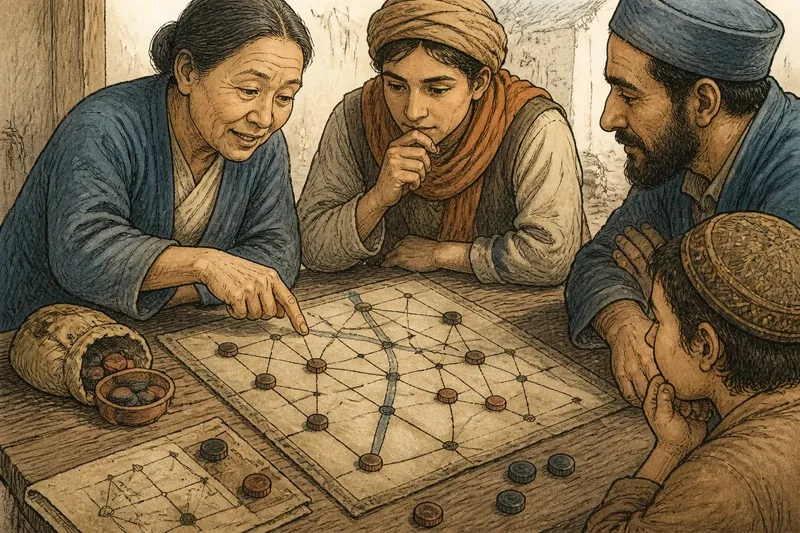
The common mistake in tracing how games passed through play is to treat oral teaching as a substitute for a missing rulebook; that leaves out what changed as people taught one another. A game could travel with its moves intact while its names, penalties or table customs shifted. The cost was not simply confusion: later players might inherit a local version without knowing it had ever been different.
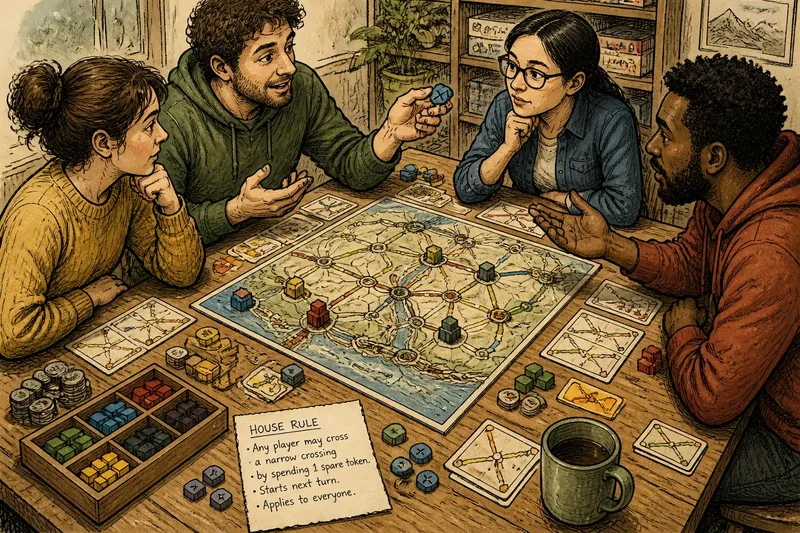
Imagine a clearly hypothetical game called River Gate, known in one village through an older relative’s demonstrations. A travelling player learns it there, then teaches it in another town, where players add a rule for a blocked crossing. This invented chain is useful because it separates three things often bundled together: the game’s core procedure, remembered explanations and local choices.
Oral transmission carried more than the rules
Before printed rules became a routine companion to games, people could learn by watching, asking and taking part. That process carried practical knowledge: how pieces moved, what counted as a win, and how players handled disputes. It also transmitted social expectations, such as whether a learner could ask for a move to be repeated or whether players settled unclear cases together.
Spoken teaching was not a single, fixed method. A player might explain the aim before play, demonstrate a move, or tell a story about why a particular piece had its name. The balance depended on who was teaching, what the learners already knew and what materials were available.
When a game travelled, its social rules could travel with it—or be replaced by the habits of the new table.
Memory preserved patterns while allowing variation
A spoken rule is easier to remember when it is tied to an action: a piece may move along connected lines, or a player wins by reaching a marked space. Yet remembered rules can differ in detail. A group may recall the same aim and movement but disagree about whether a blocked piece can retreat, or whether a tie is replayed.
Those differences do not always mean someone has forgotten the game. They may reflect a local variant that was taught as ordinary practice. Historians therefore need to distinguish evidence for a game’s broad family resemblance from evidence for one exact historical rule set. A later written account may record one version, not every version people once played.
For River Gate, the traveller remembers movement and the winning aim but not what happens at a blocked crossing. In the new town, players choose a rule and teach it onward. The resulting version is still recognisably related, but its lineage now includes a local decision.
Objects and language helped people teach a game
A board, marked ground or arranged set of counters can act as a memory aid. Pointing to a route makes a movement rule easier to communicate than reciting it without a shared object. A familiar phrase or piece name can help too, though words may change as a game crosses languages or generations.
Not every game needed a purpose-made board. Players could use whatever surface and objects were at hand, adapting the explanation to them. That flexibility made play possible in different settings, but it could also make a rule harder to reconstruct when the original materials or terminology were lost.
For a historical account, record both the words people use and the actions they demonstrate. One without the other may leave important meaning unresolved.
How can historians tell what a game’s rules were?
Can oral accounts establish one original rule set?
Usually, an oral account is evidence of what a person or community remembers and practises, not automatic proof of a single original version. Compare accounts with surviving boards, pieces, written descriptions and the contexts in which people learned the game.
Why do different communities teach different rules?
Groups may preserve local conventions, adapt play to available materials or resolve an unclear situation in different ways. A difference can represent variation rather than a simple error.
What can a board reveal if no rules survive?
A board’s layout can suggest possible movement or aims, especially when paired with pieces and accounts of play. By itself, it rarely settles every question about turn order, victory or special cases.
Why write down an oral version now?
A careful record can preserve a living account before its teachers and terminology are lost. Note who supplied the account, what they demonstrated, where uncertainty remains and whether the version is local rather than universal.
A careful record keeps variants visible
Suppose a local history group records River Gate from two older players. The first describes a blocked crossing as stopping movement; the second recalls that a piece may retreat instead. The group writes both accounts separately, notes that neither player can confirm the other’s version, and labels the retreat rule as a remembered variant rather than choosing one as the original. The result is a record that preserves useful evidence without disguising uncertainty.
For anyone documenting a game, check the account against the material and the setting:
- Observe whether the player states a clear winning aim; if both accounts agree, record it as shared evidence, but if they differ, keep the aims separate.
- Observe a full ordinary turn; if the movement matches the spoken description, record both, but if it does not, note the discrepancy instead of silently correcting it.
- Observe which objects or board marks the account depends on; if they are present, describe their role, but if they are missing, mark the explanation as incomplete.
- Observe whether a rule is described as customary or compulsory; if the speaker distinguishes the two, preserve that wording, but if not, avoid presenting a custom as a formal rule.
- Observe where the account came from and how the speaker learned it; if a teacher or place is remembered, include that chain, but if not, say the transmission history is unknown.
- Observe whether another player recalls a conflicting detail; if accounts disagree, record each version, but if they agree, note the shared point without claiming it is universal.
Games passed through play are best understood as histories of people teaching, adapting and remembering together. The practical point for a present-day recorder is simple: preserve the speaker’s version faithfully, and make uncertainty visible rather than smoothing it away.